
Why Client Pickup Is Part of Your Brand Experience

Why Client Pickup Is Part of Your Brand Experience A client’s experience with your company begins before the meeting. It starts when the client lands at the airport, leaves the arrival area, meets the chauffeur, enters the vehicle, and begins the journey to the hotel, office, or meeting venue. Each moment can influence how organised, professional, and thoughtful your company feels. That is why a client pickup service is not just a way to move a guest from one place to another. It is part of your brand experience. A clear pickup plan, a suitable vehicle, a professional chauffeur, and comfortable travel can help your client arrive with confidence. On the other hand, unclear instructions, a late vehicle, or poor communication can create stress before the business conversation begins. For companies arranging airport transfers, executive travel, and delegate transportation in Delhi NCR, a professional corporate chauffeur service can help create a smoother first impression. Key Takeaways •Client pickup is one of the first direct experiences a guest has with your company. •Professional airport transfers show preparation, respect, and attention to detail. •A good pickup plan includes the flight number, terminal, passenger details, luggage, destination, and contact information. •A chauffeur-driven service can provide comfort, privacy, professional presentation, and better coordination. •Fiaara provides premium corporate taxi and chauffeur-driven transportation for executives, clients, VIP guests, teams, and business events. Confirm current availability and service terms before booking. What is a client pickup service? A client pickup service is a planned transportation arrangement for collecting a customer, executive, business partner, guest, or delegate from an airport, hotel, residence, office, or event venue. It can include: •An airport pickup for an international client. •A hotel transfer for a visiting executive. •An office pickup for a meeting or presentation. •Transportation for a business delegation. •Vehicles for a conference or corporate event. •A full-day chauffeur service for several meetings. •A departure transfer at the end of a business visit. The purpose is not only to transport the passenger. It is to make the arrival and journey clear, comfortable, and connected to the company’s wider schedule. A professional client pickup service should answer simple questions before the journey begins: 1.Where will the chauffeur meet the passenger? 2.How will the passenger identify the vehicle or driver? 3.Who should the passenger contact if the flight or schedule changes? 4.Is the vehicle suitable for the passenger and luggage? 5.Where is the passenger travelling next? 6.Has enough time been allowed for airport procedures and traffic? When these details are managed well, the client does not need to solve transport problems after a long flight. Why is client pickup part of your brand experience? Client pickup is part of your brand experience because it is a direct interaction between the guest and your company’s standards. Before your team presents a proposal or begins a meeting, the guest is already experiencing your level of planning and care. A well-managed pickup can communicate: •Professionalism: Your company has planned the visit carefully. •Respect: The guest’s time and comfort matter. •Reliability: Important details have been checked in advance. •Confidence: The visitor knows what to expect next. •Privacy: The guest has a calm and respectful travel environment. •Attention to detail: The journey has been designed around the passenger’s needs. This does not mean every client needs the most expensive vehicle. Brand experience is created by consistency. The right vehicle, clear information, polite service, and accurate coordination often matter more than exaggerated luxury. The journey before the meeting Imagine a client arriving in Delhi for an important business meeting. They have just completed a long international journey. They may be tired, unfamiliar with the airport, and unsure about local traffic or meeting points. A prepared company sends a clear message before departure. It shares the pickup instructions, driver contact, destination, and support number. The client reaches the vehicle without confusion. The chauffeur welcomes them professionally, and the journey begins in a calm environment. That experience does not replace the quality of the meeting. However, it creates the right conditions for the relationship to begin well. How does airport pickup affect a client’s first impression? Airport pickup is often one of the first physical touchpoints between an organisation and an international client or business visitor. A smooth arrival can help the guest feel welcome and prepared. A confusing arrival can create tension before the first meeting. The travel coordinator should share these details with the client before departure: •Airport name and arrival terminal. •Flight number and expected arrival time. •Passenger name and contact number. •Meeting point or pickup instructions. •Chauffeur or coordination contact. •Hotel, office, or meeting destination. •Vehicle description or category. •Instructions for delays or changes. Delhi Airport provides prepaid and app-based cab options at T1, T2, and T3. These options may suit many travellers. A pre-arranged corporate airport transfer is useful when the passenger is an important client, senior executive, international guest, or delegate with a time-sensitive itinerary. Delhi Airport’s official cab and taxi guidance confirms that cab options are available outside the arrival gates at all three terminals. A corporate chauffeur service adds a planning layer around the transport. The provider can receive the passenger brief before arrival, while the company can give the guest one clear process to follow. [INTERNAL-LINK: Delhi Airport transfer guide → guide for international and corporate travellers arriving in Delhi] What makes a professional client pickup experience? A professional client pickup experience is planned around the guest’s needs and the company’s schedule. It should be calm, clear, and easy for the passenger to follow. 1. Accurate booking information The booking should contain the correct flight number, terminal, passenger name, destination, and contact details. Small errors can create unnecessary delays, especially when the guest is unfamiliar with the airport. 2. Simple meeting instructions The passenger should know where to go after immigration and baggage collection. Avoid sending a long or confusing message. Give simple instructions and provide one reliable contact channel. 3. A suitable vehicle The vehicle should match the passenger count,
Why Businesses Should Use a Dedicated Corporate Taxi Service

Business travel is not only about reaching a destination. It is also about time, comfort, professional presentation, guest experience, and clear coordination. When employees, executives, clients, or international delegates travel for work, ordinary transport arrangements can create unnecessary problems. The vehicle may not be suitable, pickup details may be unclear, billing may be difficult to track, or the traveller may need to arrange a new ride for every journey. A dedicated corporate taxi service gives businesses a more organised way to manage airport transfers, meetings, client visits, conferences, employee travel, and executive movement. This guide explains the main benefits of using a corporate taxi service, what to check before choosing a provider, and how Fiaara can support premium business travel requirements. Key Takeaways •A corporate taxi service is designed for business travel, not just one-time point-to-point rides. •Businesses can use a dedicated provider for executive airport transfers, client pickups, meetings, events, and employee travel. •The most important factors are professional chauffeurs, suitable vehicles, clear communication, privacy, safety processes, and transparent billing. •A corporate account can simplify repeat bookings, monthly invoicing, and trip reporting. •Fiaara offers corporate chauffeur and taxi services for executive travel, airport transfers, VIP guests, teams, and business events. Confirm current availability and service terms before booking. What is a dedicated corporate taxi service? A dedicated corporate taxi service is a professional transport solution arranged specifically for companies and business travellers. It may include chauffeur-driven airport transfers, office travel, client transportation, employee commutes, event movements, and multi-stop business itineraries. Unlike an occasional taxi booking, a corporate service is built around the company’s travel needs. The provider may manage passenger details, vehicle selection, booking coordination, support, invoices, and trip records through one organised process. The word “dedicated” does not always mean that one vehicle is reserved permanently for one company. It means the business has a defined transport partner and a more consistent booking and support system. For example, a company may use a corporate taxi provider to: •Pick up an international executive from the airport. •Take a client from a hotel to an office or meeting venue. •Move a group of delegates between meetings. •Arrange vehicles for a conference or corporate event. •Support employees travelling between offices. •Book a chauffeur-driven car for a full day of meetings. Why should businesses use a corporate taxi service? Businesses should use a corporate taxi service when transport quality, time management, passenger comfort, privacy, and administrative control matter. A dedicated provider helps turn individual rides into a planned business travel process. The main advantages include: 1.Better time management 2.Professional airport transfers 3.Improved client and guest experience 4.Suitable vehicles for different passengers 5.More privacy and comfort 6.Simpler corporate billing 7.Easier support for recurring travel 8.Better coordination for events and delegations The right service will not remove every travel delay. Flights, airport procedures, traffic, weather, and meeting schedules can change. However, a professional transport partner can make the plan clearer and reduce avoidable confusion. 1. A corporate taxi service helps protect valuable business time Time is one of the biggest reasons companies choose professional business transportation. Executives and employees often move between airports, hotels, offices, meeting venues, and events. If every trip requires a new booking and new pickup instructions, valuable time can be lost. A dedicated corporate taxi service can help by organising the journey around the traveller’s schedule. The booking team can share the flight number, arrival terminal, meeting address, passenger details, and required vehicle category before the journey begins. For an executive, the journey can also provide time to: •Review the next meeting. •Make business calls. •Respond to important messages. •Rest after a long flight. •Prepare for a presentation. •Discuss the schedule with a colleague. A chauffeur-driven car does not guarantee that the journey will be free from traffic or delays. Its value is that the passenger does not need to focus on driving, parking, navigation, or finding a new ride. 2. It creates a smoother executive airport transfer An executive airport transfer should be planned before the passenger lands. A clear booking should include the passenger name, flight number, arrival terminal, destination, luggage details, and a practical communication channel. Delhi Airport states that prepaid and app-based cab options are available at T1, T2, and T3. These are useful options for many passengers. A pre-arranged corporate chauffeur service is different because the company can brief the provider around the passenger’s wider business itinerary. Delhi Airport’s official taxi guidance confirms that passengers can access cab options outside the arrival gates at all three terminals. A dedicated corporate airport transfer is especially useful when: •The passenger is visiting India for the first time. •An international client or senior executive is arriving. •The traveller has a meeting soon after landing. •The company is responsible for a delegate or guest. •The passenger has several bags or special vehicle requirements. •The journey includes a hotel, office, conference venue, or another city. The objective is simple: the passenger should know what to do next after collecting baggage and leaving the arrival area. [INTERNAL-LINK: Delhi airport taxi guide → guide to planning an airport pickup for international and corporate travellers] 3. A professional car service improves the client experience A client’s experience begins before the meeting starts. The airport pickup, hotel transfer, and journey to the office all contribute to how organised and considerate the host company appears. A dedicated corporate taxi service can support a better guest experience through: •Clear pickup instructions. •A vehicle suitable for the guest and luggage. •Professional chauffeur conduct. •Respectful communication. •A comfortable and private travel environment. •Coordination with the host or travel assistant. This does not require exaggerated luxury language. In practice, many guests value simple things: the correct vehicle, accurate information, a clean interior, polite service, and no confusion about where to go. For international visitors, these details are even more important because they may be unfamiliar with the airport, traffic conditions, local routes, or communication systems. A prepared airport transfer can help them begin the visit with greater confidence.
Luxury Corporate Travel in Delhi: Why Chauffeur Service Matters for Executives

For a senior executive, a journey between Delhi Airport, a hotel, an office, and a meeting venue is part of the working day. It affects punctuality, preparation, comfort, privacy, and the impression created for colleagues, clients, and visiting delegates. That is why luxury corporate travel is about more than booking a premium car. It is a coordinated ground-transport experience designed around the traveller’s schedule and responsibilities. A professional chauffeur service can help reduce avoidable friction across airport pickups, client movements, meetings, conferences, and multi-day business itineraries. For companies arranging executive travel in Delhi NCR, the practical question is not simply, “Which car should we book?” It is, “How should this journey be managed so the traveller can focus on the purpose of the trip?” Key Takeaways •Executive ground transport should be planned as part of the business itinerary, not as an afterthought. •The most useful chauffeur-service criteria are coordination, professional conduct, vehicle suitability, communication, privacy, and billing clarity. •A dedicated airport transfer can give international executives and visiting delegates a more predictable transition from Delhi Airport to their next engagement. •Corporate travel teams should ask about flight details, terminal, passenger requirements, support channels, invoices, and reporting before confirming a provider. •Fiaara’s corporate service page describes chauffeur-driven vehicles, GPS-tracked fleet management, 24/7 control-room monitoring, corporate accounts, and executive travel support. Current service scope and availability should be confirmed directly with Fiaara. What is luxury corporate travel? Luxury corporate travel is business transportation planned around executive time, comfort, discretion, and operational reliability. It can include airport transfers, hotel-to-office journeys, client pickups, meeting transfers, event movements, and coordinated transport for a group of delegates. The word “luxury” should not be reduced to a vehicle badge or leather seats. In a corporate context, luxury is often experienced as a well-managed journey: the booking details are correct, the vehicle suits the passenger, the chauffeur is professional, the communication is clear, and the traveller does not need to solve transport problems while handling business responsibilities. A corporate chauffeur service is therefore different from an occasional taxi booking. It is a service layer around the journey, with greater attention to planning, presentation, guest handling, and administrative follow-through. corporate travel solutions in Delhi NCR → Fiaara’s corporate service page Why does chauffeur service matter for executives? Chauffeur service matters because executive travel has a higher cost of disruption. A missed meeting, unclear airport pickup, uncomfortable vehicle, or poorly communicated change can affect more than one passenger. It can delay a negotiation, inconvenience a client, or put a delegation under unnecessary pressure. A chauffeur-driven transfer can support the business journey in five practical ways: 1.It protects attention. The passenger can review the next meeting, make calls, or rest rather than navigate traffic and parking. 2.It creates a more controlled arrival. The journey begins with confirmed details instead of last-minute decisions outside the terminal. 3.It supports professional presentation. A clean, appropriate vehicle and well-managed pickup are part of the guest experience. 4.It improves privacy. Executives may need a quiet environment for confidential calls or personal space between meetings. 5.It simplifies responsibility. A company or travel coordinator has one provider to brief about the journey requirements. These benefits are most relevant when the itinerary is time-sensitive, the traveller is visiting Delhi for the first time, or the company is responsible for an important guest or delegation. Why is an executive airport transfer different from a regular Delhi airport taxi? A regular taxi may be perfectly suitable for a simple point-to-point journey. An executive airport transfer is designed for a passenger whose arrival is connected to a broader schedule, relationship, or business objective. The difference usually appears in the planning process rather than in the road route. A corporate transfer should account for the passenger’s flight, terminal, luggage, destination, arrival communication, vehicle category, and onward appointment. The provider should also explain the pickup process clearly before the traveller departs. Delhi Airport’s official international-arrival guidance directs passengers through immigration, baggage collection, customs, and designated transport areas. It also recommends checking current airport and airline updates because procedures and advisories can change. Delhi Airport’s International Arrival Guide is a useful reference for executive travel coordinators preparing an arrival plan. For the booking team, an executive airport transfer brief should include: •Passenger name and mobile or WhatsApp contact. •Airline, flight number, arrival date, and expected arrival time. •Confirmed arrival terminal. •Hotel, office, conference venue, or residence address. •Number of passengers and luggage requirements. •Requested vehicle category or passenger preferences. •Meeting time or onward travel constraints. •A contact person responsible for changes on the day. The goal is not to promise that every delay can be eliminated. The goal is to make the journey understandable and coordinated before the traveller lands. What should companies look for in a chauffeur service in Delhi? A corporate travel provider should be evaluated on the complete service, not only on the advertised vehicle. Before appointing a provider, ask how it handles the following areas. 1. Professional chauffeur standards The chauffeur represents the transport provider and, in some situations, becomes part of the company’s guest experience. Look for professional communication, appropriate presentation, respectful conduct, and an understanding of passenger privacy. If English-language coordination is important for international guests, confirm the provider’s current capability in advance. 2. Fleet suitability A premium sedan may suit a solo executive, while an SUV or larger vehicle may be more appropriate for a delegation or passengers with substantial luggage. Request the vehicle category that fits the itinerary rather than selecting a model only for its name. Fiaara’s corporate service page lists options including Honda City and Toyota Camry for daily commute requirements, Mercedes E-Class and BMW 5 Series for VIP guests, and Toyota Innova Hycross and Kia Carnival for teams. Vehicle availability can vary by date, route, and booking conditions, so the exact allocation should be confirmed before travel. Fiaara Corporate Taxi Service 3. Clear coordination and support A company arranging executive movements needs a practical communication channel before and during travel. Ask who handles
Corporate Pick and Drop Service in Delhi NCR: A Practical Guide for Businesses
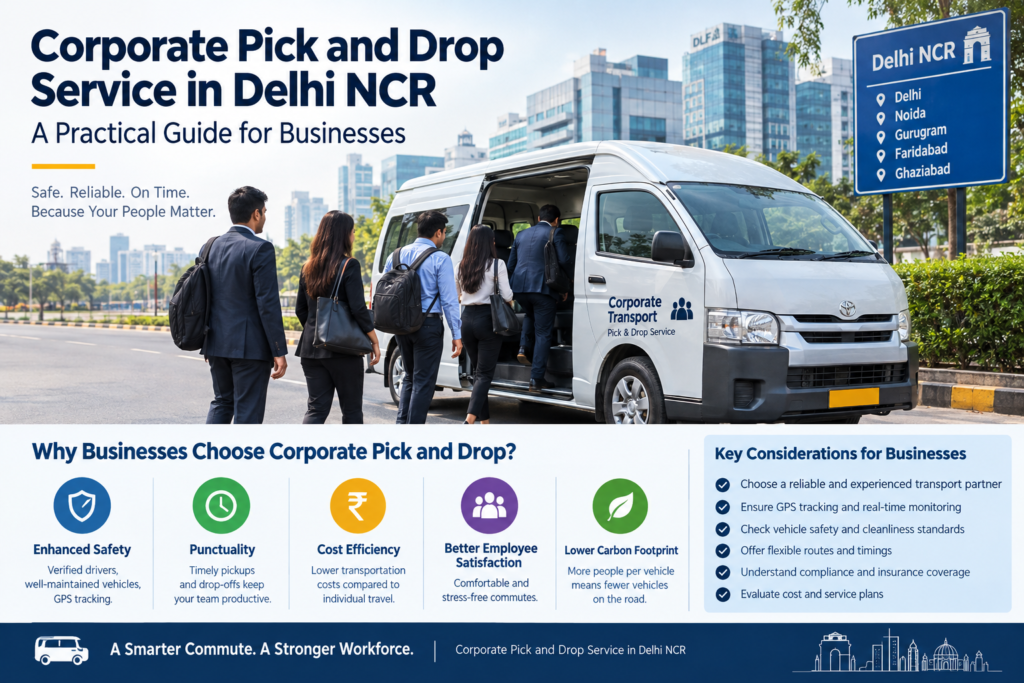
In Delhi NCR, a meeting at Cyber City, a flight from Terminal 3 and a client dinner in Connaught Place can all land in the same day. If transport for any of them goes wrong, it affects the whole schedule. That is why more companies now use a dedicated corporate pick and drop service instead of relying on ad-hoc app cabs. This guide covers what a corporate pick and drop service includes, who needs one, and what to check before you pick a provider. What Is a Corporate Pick and Drop Service? A corporate pick and drop service is a pre-arranged, chauffeur-driven transport service for a company’s people and guests. A professional driver collects the passenger from a fixed location and drops them at the destination on a confirmed schedule. The location can be a home, hotel, office or airport. It is different from hailing a cab on demand. The booking is planned in advance, the vehicle and chauffeur are assigned beforehand, and the company can track the ride. Who Uses It? Key Benefits for Businesses 1. Punctuality you can plan around. Rides are booked in advance and the chauffeur knows the route and timing. This matters most for early flights and back-to-back meetings. 2. Consistent service quality. You get a trained, professional chauffeur and a well-maintained vehicle every time, with no surprises on cab type or driver behaviour. 3. Transparent, pre-agreed pricing. Fixed pricing means no surge during peak hours or bad weather. Finance teams can budget and reconcile expenses much more easily. 4. Comfort and privacy. Executives can take confidential calls or review documents in a quiet, comfortable cabin. 5. Safety and accountability. Chauffeur-driven services with tracked vehicles and 24/7 support give HR and admin teams much better visibility than random pick-ups. Common Corporate Pick and Drop Scenarios Airport pick-up and drop. Delhi traffic is unpredictable, so airport runs are where planned transport helps most. A chauffeur tracks the flight, waits at arrivals and handles the luggage. Read more in our guide to business airport transfers for executives and the benefits of pre-booking your airport transfer. You can also book directly through our Delhi airport taxi service. Daily executive movement. Home to office, office to meetings, and meetings to the airport. A dedicated chauffeur or a fixed monthly arrangement keeps this smooth. Our city transfer service covers point-to-point travel across Delhi, Gurugram, Noida, Ghaziabad and Faridabad. Client and guest hospitality. For important guests, the car is the first thing they experience. A premium vehicle with a courteous chauffeur sets the tone before the meeting even starts. Our private corporate transportation in Delhi post explains why executives prefer this over standard cabs. Multi-city and outstation business trips. Travel to Jaipur, Agra or Chandigarh for a meeting is easier with one provider handling the whole itinerary. Our corporate taxi service page covers business tour options. How to Choose the Right Provider Before you sign up, check these points: For a fuller checklist, see how to choose a luxury taxi service in Delhi NCR. How Fiaara Handles Corporate Pick and Drop Fiaara has served Delhi NCR since 2012 with a fleet that ranges from comfortable sedans and SUVs to premium Mercedes, BMW and Audi vehicles. For corporate clients we offer: Book Your Corporate Pick and Drop Planning transport for your team or a visiting guest? Contact Fiaara with your pick-up location, drop location, date and time, and we will confirm your booking quickly. You can also reach us on WhatsApp. FAQs What is a corporate pick and drop service?It is a pre-booked, chauffeur-driven service that collects employees, executives or guests from one location and drops them at another on a fixed schedule. Can I book it for just one trip?Yes. You can book a single transfer, such as an airport pick-up for a client, or arrange recurring rides for regular needs. Do you cover Gurugram, Noida and the rest of NCR?Yes. Fiaara serves Delhi, Gurugram, Noida, Ghaziabad and Faridabad. Is the pricing fixed?Yes. Rates are agreed at the time of booking, so there is no surge pricing. Can I get transport for a group or event?Yes. We can arrange multiple vehicles for events, conferences and delegations.
Why Executive Travellers Choose Private Corporate Transportation in Delhi

Why Executive Travellers Choose Private Corporate Transportation in Delhi For an executive traveller, transportation is not simply the distance between an airport, a hotel, and a meeting venue. It is the transition between important moments. A delayed pickup, unclear meeting point, uncomfortable vehicle, or last-minute change can add unnecessary pressure to an already demanding schedule. A well-coordinated private corporate transportation service helps make that transition calmer, clearer, and more professional. Dubai is a major international destination for business meetings, conferences, investment activity, and executive travel. The Dubai Department of Economy and Tourism reported 19.59 million international overnight visitors in 2025, a 5% increase from 2024 (Dubai Department of Economy and Tourism, Tourism Performance Report January–December 2025). As business travel continues to connect companies, clients, and delegates across borders, the quality of ground transportation becomes part of the overall travel experience. This guide explains why executives and corporate travel planners choose private transportation, what to look for in a provider, and how a considered transfer service can support better business travel in Dubai. Key Takeaways •Private corporate transportation gives executives a more organised transition between airports, hotels, offices, venues, and meetings. •The main benefits are not only comfort, but also privacy, clear coordination, professional presentation, and reduced travel-related decision-making. •Companies should evaluate a provider based on communication, punctuality, discretion, itinerary flexibility, and the practical needs of the traveller. •Fiaara supports a more considered approach to executive and delegate movement, without adding unnecessary complexity to the journey. [INTERNAL-LINK: airport transfer service in Dubai → Fiaara airport transfer service page] What Makes Corporate Transportation Different from Everyday Travel? Everyday transportation is usually arranged around a single point-to-point journey. The traveller selects a pickup location, chooses a vehicle, and focuses on reaching the destination. Corporate travel often involves more moving parts. An executive may arrive at an airport, continue to a hotel, travel to a meeting, move to a conference venue, and return to the airport within a short period. A visiting delegate may also need coordinated movement between several locations while carrying luggage, documents, or equipment. The difference is therefore not simply the type of vehicle. It is the level of planning around the journey. Corporate transportation is designed to support the traveller’s schedule, privacy, comfort, and professional responsibilities. When the movement is planned clearly, the traveller can spend less time solving transport problems and more time preparing for the work ahead. Deloitte’s 2025 Corporate Travel Study found that three out of four surveyed travel managers expected their company’s travel budgets to expand during the year, even as companies applied more scrutiny to travel value and costs Deloitte, “Forecast in flux: 2025 Deloitte Corporate Travel Study,” 2025). The finding points to a more deliberate approach to business travel: companies are not only asking whether travel should happen, but also how each trip can be managed more effectively. 1. Better Time Management for Executives and Delegates Time is one of the clearest reasons executive travellers choose private corporate transportation. A business itinerary rarely consists of one simple journey. It may include a flight arrival, hotel check-in, a client meeting, a site visit, a conference session, and an evening transfer. Each movement creates a small planning requirement. When those requirements are handled separately, the traveller carries the responsibility for every pickup, route, and timing decision. Private transportation allows the journey to be considered as part of the wider itinerary. Airport arrival details, pickup instructions, destination information, and additional transfers can be shared in advance. This does not remove the need for good communication or realistic scheduling, but it can reduce the number of decisions the traveller must make after landing. For a travel manager, this also creates a clearer process. Instead of asking several executives or delegates to arrange individual transfers, the movement can be coordinated around the programme. The result is a more organised experience for the traveller and a simpler point of communication for the person managing the trip. 2. Privacy During the Journey Business travel often involves information that should not be discussed in public spaces. Executives may need to make a confidential call, review meeting notes, prepare a presentation, or simply have a quiet moment between appointments. A private vehicle can offer a more respectful environment for that transition than a crowded public setting or an unpredictable shared ride. Privacy is not about creating an exaggerated luxury experience. It is about giving the traveller personal space and allowing the journey to remain focused. Professional service also means avoiding unnecessary conversation, handling travel details respectfully, and recognising that not every passenger wants attention during the ride. For companies, this matters because the travel experience reflects how visiting clients, partners, and senior employees are treated. A quiet and discreet transfer can support a sense of professionalism without making claims that cannot be guaranteed. The provider’s communication, conduct, and attention to detail are often as important as the vehicle itself. 3. A More Professional Arrival The first few minutes of a business visit can influence the tone of the day. A guest who is unsure where to meet, searching for a vehicle, or trying to solve a luggage problem may begin the visit with avoidable frustration. Clear arrival coordination helps create a more composed first impression. This is especially relevant when a company is welcoming a client, partner, investor, speaker, or international delegate. The transportation experience does not need to be showy. It needs to be reliable in its communication, respectful in its conduct, and aligned with the importance of the traveller’s schedule. A professional arrival also supports the reputation of the organisation arranging the movement. When the airport pickup, hotel transfer, or meeting journey is handled with care, the guest receives a practical signal that their time and comfort have been considered. 4. Comfortable Transitions Between Meetings A full business day can involve several transitions. The traveller may move from an airport to a hotel, from a hotel to an office, from an office to an event, and from an event to
A Calm, Comfortable Arrival for International and Corporate Travellers

Delhi Airport Taxi: A Calm, Comfortable Arrival for International and Corporate Travellers Arriving in Delhi is exciting—but the first journey after landing can shape the entire trip. After a long flight, unfamiliar roads, luggage, traffic, and uncertainty about where to meet a driver can turn a simple airport transfer into an avoidable source of stress. A pre-arranged airport taxi gives international tourists, executives, and visiting delegates a clearer transition from the terminal to their hotel, residence, office, or next destination. The right service is not only about the vehicle. It is about coordination, punctuality, comfort, privacy, and having a reliable plan when you arrive. This guide explains what to look for in a Delhi Airport taxi, how to prepare for pickup, and why a chauffeur-driven transfer can be a more considered choice for your first journey in Delhi NCR. Key Takeaways •Confirm your arrival terminal, flight number, passenger name, destination, and contact details before booking. •Choose a transfer service with clear coordination, professional drivers, and a defined pickup process. •International travellers benefit from a calm, direct journey after immigration and baggage collection. •Corporate travellers should prioritise punctuality, discretion, clean vehicles, and dependable communication. •Fiaara provides premium ground transportation in Delhi NCR, with chauffeur-driven options for tourists and business travellers. Confirm availability and booking details directly with the Fiaara team. What is the best airport taxi option in Delhi? The best airport taxi option is one that matches your arrival requirements and gives you a clear, dependable transfer plan. Before selecting a service, check five essentials: pickup coordination, terminal coverage, vehicle suitability, driver professionalism, and transparent booking communication. Delhi Airport’s official transport information states that cab options are available from all three terminals—T1, T2, and T3—including prepaid and app-based services. The airport also advises passengers that cabs are available outside the arrival gates. Delhi Airport’s cab and taxi guidance is a useful reference when comparing transport options. For a tourist travelling with luggage, a direct transfer to the hotel may be the simplest choice. For a corporate leader or delegation, the priorities may be different: the driver should know the meeting point, the itinerary should allow for traffic, and the service should protect the traveller’s time and privacy. Airport taxi checklist before you book Booking detail Why it matters Flight number and arrival date Helps the service identify the correct arrival and plan coordination. Terminal: T1, T2, or T3 Delhi Airport has multiple terminals, so the terminal should be confirmed in advance. Passenger and luggage details Helps the provider suggest a suitable vehicle. Hotel, residence, or office address Avoids delays caused by incomplete destination information. Mobile or WhatsApp contact Creates a practical channel for arrival-day communication. Passenger requirements Families, executives, delegates, and travellers with special needs may need different arrangements. Why pre-book a Delhi Airport transfer? Pre-booking removes several decisions from the most tiring part of an international journey. Instead of stepping outside the terminal and comparing options while managing luggage, you can arrive with the essential details already shared with the transfer provider. A pre-booked transfer is especially useful when: 1.You are visiting Delhi for the first time. A planned pickup can reduce uncertainty in an unfamiliar city. 2.You arrive late at night or early in the morning. You can organise the journey before departure rather than searching after landing. 3.You are travelling with family or several bags. The provider can confirm vehicle suitability ahead of time. 4.You have a meeting soon after landing. A carefully planned transfer supports better time management. 5.You are responsible for a guest or delegation. One coordinated booking is easier to communicate and monitor than several separate arrangements. Pre-booking does not eliminate every travel variable. Flights can be delayed, baggage collection can take longer than expected, and Delhi traffic can change during the day. A responsible airport taxi provider should therefore communicate clearly about the pickup process and any information needed from the passenger. What should international tourists expect from an airport taxi in Delhi? International visitors usually want three things immediately after landing: clarity, comfort, and confidence about the next step. A good Delhi Airport pickup should make it easy to understand where to go, whom to contact, and how the journey to the destination will begin. Before your flight, keep the following information accessible: •Your booking confirmation and provider contact details. •The terminal and arrival flight number. •Your hotel or destination address, including the city and postal code where relevant. •A local contact number if you have one; otherwise, confirm how you will contact the driver through Wi-Fi or messaging. •Passport, visa, and travel documents required for entry into India. •Details of children, older passengers, or large luggage items travelling with you. The official Delhi Airport website provides passenger guidance on airport processes and travel advisories. Check the airport’s travel advisory page close to your journey, especially if there are changes affecting traffic, security, baggage, or airport access. A smoother arrival sequence A simple arrival plan can look like this: 1.Land and complete immigration formalities where applicable. 2.Collect checked baggage and confirm that you have all personal items. 3.Connect to Wi-Fi or your agreed communication channel if needed. 4.Follow the pickup instructions provided with your booking. 5.Confirm the vehicle and driver details before leaving the terminal area. 6.Settle into the vehicle and share any important onward timing with the driver or coordination team. The purpose of a premium airport taxi is not to make unsupported promises about every part of an arrival. It is to give the traveller a well-organised, respectful start to the journey. Why is a chauffeur-driven airport taxi useful for corporate travellers? For corporate travellers, an airport transfer is part of the working day—not simply a ride between two points. A dependable chauffeur-driven service can create time to make calls, review the day’s schedule, or rest before a meeting, while a professional arrival supports the traveller’s wider business impression. Corporate travellers should evaluate an airport taxi against these practical criteria: •Punctual coordination: The transfer details are confirmed before arrival.
What Really Makes a Luxury Taxi Service Premium in Delhi NCR?
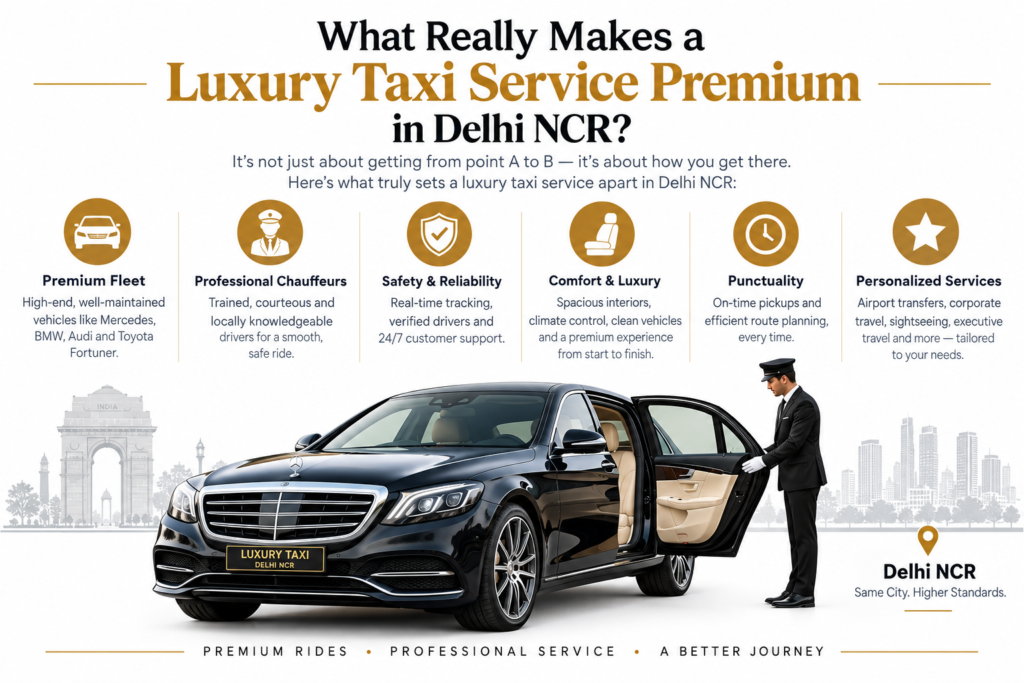
Introduction: Luxury Is a Service Experience, Not a Badge Key Takeaways 1. Does the Vehicle Match What Was Promised? 2. Is the Chauffeur Briefed, Professional, and Punctual? 3. Was the Price Explained Before the Trip? 4. Is There Someone to Call When Plans Change? 5. Comfort and Safety Must Be Consistent 6. A Simple Pre-Booking Checklist for Luxury Taxi Services A practical checklist readers can use before confirming a booking: 7. The Difference Between Buying an Image and Booking a Service FAQ: Choosing a Chauffeur-Driven Car in Delhi NCR What makes a taxi service genuinely luxurious? A genuinely luxurious taxi service combines a suitable vehicle with professional chauffeur conduct, punctuality, safety, transparent pricing, and dependable support. Should I confirm the exact car model before booking? Yes. Ask whether the vehicle is guaranteed or subject to availability, and confirm the category, seating capacity, luggage space, and key amenities. What should be included in a chauffeur-service quote? The quote should clearly explain the fare, inclusions, waiting time, tolls, parking, extra stops, taxes, cancellation terms, and any possible surcharges. Is chauffeur service better than booking a regular cab? For business travel, airport transfers, events, and important journeys, a chauffeur service generally offers greater planning, consistency, comfort, and accountability. What should I check before booking a luxury taxi in Delhi NCR? Check the confirmed vehicle, chauffeur details, pickup timing, pricing terms, support contact, delay policy, and service reputation. Conclusion: Premium Travel Is Measured in Details Planned Visual Rhythm Please approve this outline, or tell me what you would like changed before I write the full article.
How to Choose a Luxury Taxi Service in Delhi NCR | FIAARA
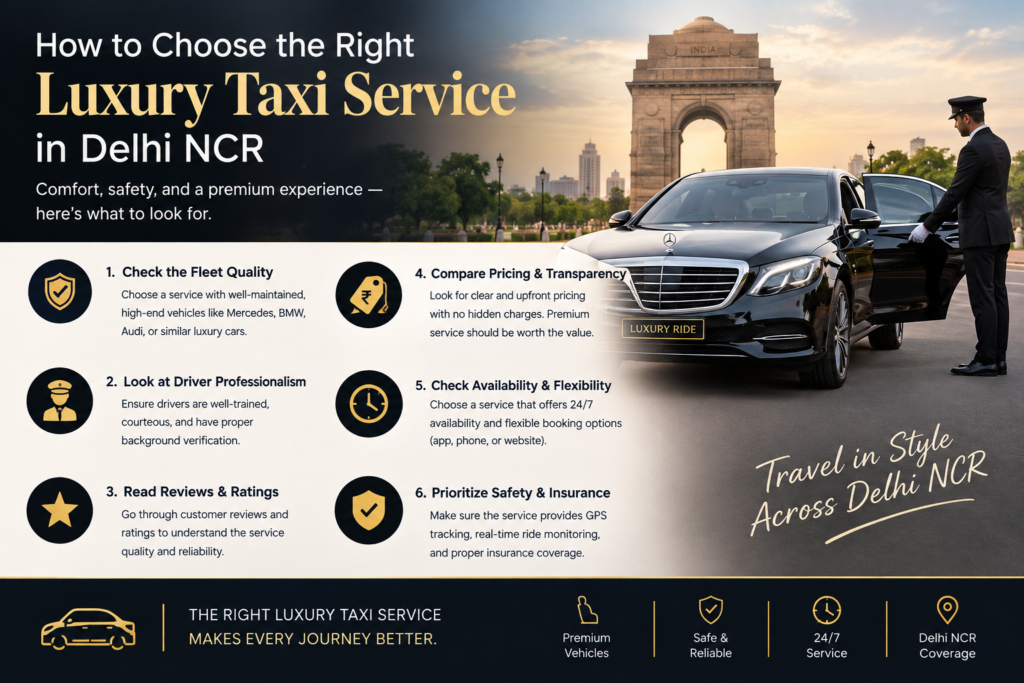
How to Choose the Right Luxury Taxi Service in Delhi NCR Quick answer: The right luxury taxi service in Delhi NCR is one that confirms your vehicle, chauffeur and price before the trip, arrives on time, and has a clear process for changes and support. Compare providers on fleet quality, chauffeur professionalism, transparent pricing, safety practices and how well they handle your specific type of trip. Booking a premium car in Delhi NCR sounds simple until you compare options. Two providers can both say “luxury,” yet one delivers a spotless car, a well-briefed chauffeur and a fixed quote, while the other sends a different vehicle, a late driver and a bill that changes at the end. This guide gives you a practical way to tell the difference. Whether you are arranging an airport pickup for a visiting executive, a wedding, a city tour or regular business travel, the checklist below will help you shortlist a provider with confidence. What Makes a Taxi “Luxury” (and Not Just Expensive)? A luxury taxi is not defined only by the badge on the car. It is defined by the whole experience, from the moment you enquire to the moment you reach your destination. A genuine premium cab service in Delhi typically offers: If a provider is strong on the car but weak on the other four points, you are paying for an image rather than a service. [INTERNAL LINK: /luxury-taxi-delhi-ncr “luxury taxi in Delhi NCR”] The 8-Point Checklist for Choosing a Luxury Taxi Service in Delhi NCR Use these eight checks to compare any provider. You do not need a perfect score on every point, but you should know where the gaps are before you book. 1. Vehicle quality and category Ask which vehicle you will actually get, not just which category. A sedan suits one or two passengers with light luggage, while an SUV suits families, groups or heavy baggage. Ask whether an equivalent vehicle is arranged if the first choice is unavailable. 2. Chauffeur professionalism The chauffeur shapes the entire journey. Look for a provider that emphasises trained, professional chauffeurs, and ask how they are briefed on pickup points, dress standards and passenger etiquette. For corporate and VIP guests, discretion and punctuality matter as much as driving skill. 3. Transparent pricing Ask what the quote includes and what it does not. Clarify whether tolls, parking, waiting time and night charges are included. A provider that explains its pricing clearly before the trip is far more likely to behave the same way after it. 4. Punctuality and scheduling For a pre-booked trip, ask how the provider handles timing. Do they confirm the pickup time in advance? Do they plan buffer time for Delhi traffic? This is especially important for early flights and back-to-back business meetings. 5. Safety practices Safety should be visible, not just promised. Ask about chauffeur verification, vehicle upkeep and how the provider communicates trip details. If you are arranging travel for colleagues, guests or family members, this deserves extra attention. 6. Range of services A provider that covers several trip types can usually support you as your needs change. Check whether they handle airport transfers, hourly chauffeur bookings, corporate travel, weddings and events, city tours and longer journeys. 7. Communication and support Find out how you will reach someone if plans change. A clear point of contact, prompt responses and a simple way to update pickup details make a big difference on the day of travel. 8. Fit for your specific trip The best provider for a wedding fleet is not automatically the best for a weekly executive commute. Ask for examples relevant to your requirement, whether that is a single airport pickup or a multi-car plan. Match the Service to Your Trip Different trips need different priorities. Use this table to decide what to weigh most heavily. Trip type What matters most What to confirm before booking Airport transfer Punctuality, luggage space, clear pickup instructions Terminal, flight details, passenger count, luggage Corporate and executive travel Discretion, reliability, professional chauffeur Schedule, billing process, recurring requirements Wedding and events Fleet availability, coordination, appearance Number of vehicles, guest count, timings City tour Comfort, flexibility, route knowledge Hours needed, places to visit, vehicle type Long-distance travel Comfort over distance, planning, safety Route, stops, return timing Airport transfers For arrivals, share your flight details, terminal and passenger count so the pickup can be planned properly. Keep realistic buffer time on departures, since traffic in Delhi NCR can be unpredictable. Read our full Delhi airport transfer checklist before your next trip. Corporate travel Businesses usually need consistency more than one-off convenience. If you are comparing options for regular travel, see our guide to [INTERNAL LINK: /blog/corporate-travel-solutions-delhi-ncr “corporate travel solutions in Delhi NCR”]. Weddings and events Weddings and events involve several vehicles, fixed timings and many guests. Confirm the number of cars, the schedule and a single point of coordination well ahead of the date. Red Flags to Watch For Some warning signs appear early. Be cautious if a provider: A confident, transparent provider will not mind these questions. Asking them is simply good planning. Chauffeur-Driven Car vs Regular Cab: When Is Premium Worth It? A chauffeur-driven car in Delhi is worth considering when the journey matters beyond the fare. That includes arrivals for important meetings, guests you want to look after, occasions where appearance counts, and long or multi-stop days where comfort and a dedicated driver reduce stress. For a quick, low-stakes ride, a regular cab may be enough. For planned, high-value or time-sensitive travel, a pre-booked luxury car rental in Delhi with a driver usually gives you more predictability. “chauffeur service in Delhi“ What to Expect from FIAARA FIAARA is a premium taxi and chauffeur-driven car service in Delhi NCR, built around comfort, safety, punctuality and a personalised travel experience. Its services include luxury airport transfers, corporate travel solutions, wedding and event transportation, hourly chauffeur services, city tours and long-distance rides. The approach is straightforward: professional chauffeurs, premium vehicles and transparent pricing, so
Business Airport Transfer: How to Plan Smooth Ground Transportation for Executives
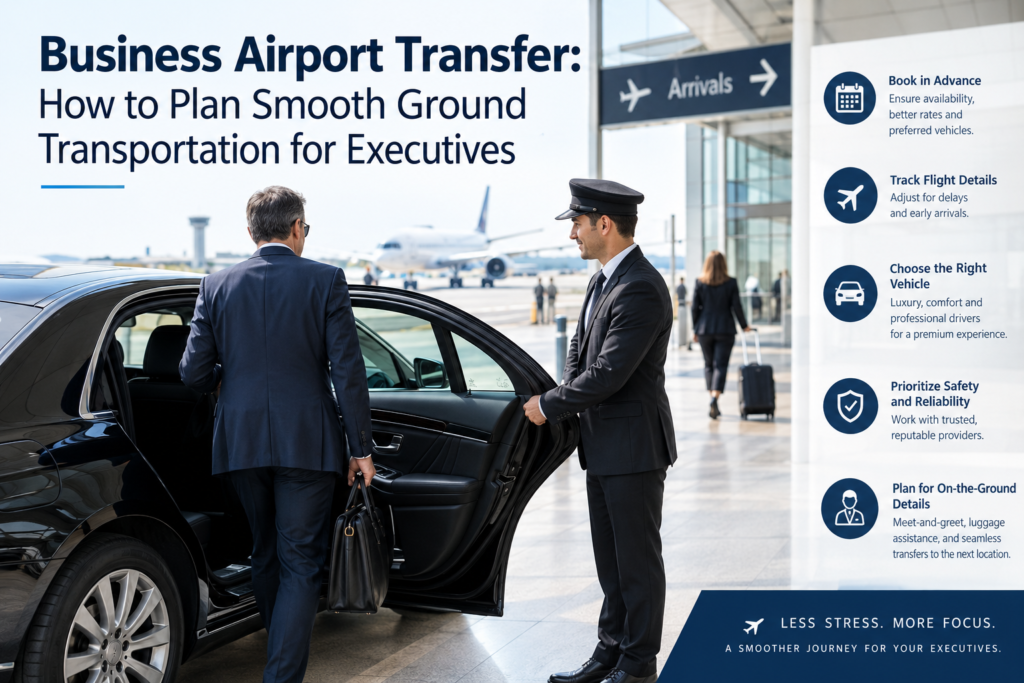
A business trip does not begin when an executive enters the meeting room. It begins when the traveller lands, collects their luggage and needs to reach the next destination on time. That first ground journey can shape the rest of the day. A clear pickup plan can make the arrival feel calm and organised. An uncertain transfer can create avoidable stress, delay preparation and leave a poor first impression of the destination. This is why a business airport transfer should be treated as part of corporate travel planning—not as a last-minute transport booking. With the right information, communication and service standards, companies can make airport-to-hotel and airport-to-meeting journeys more comfortable, discreet and dependable. This guide explains how executives, travel managers and delegation coordinators can plan business airport transfers effectively. Key Takeaways •A business airport transfer should be planned around the traveller’s schedule, luggage, destination and communication needs. •Clear pickup instructions and one responsible point of coordination reduce confusion after arrival. •Ground transportation is an important part of business travel experience, duty of care and meeting readiness. •The right provider should be assessed for communication, professionalism, privacy, flexibility and service fit—not only price. Why Does a Business Airport Transfer Matter? A business airport transfer connects several important parts of a corporate journey: the flight, accommodation, meetings, local travel plan and return departure. When the transfer is well coordinated, the traveller can move from arrival to the next commitment without making unnecessary decisions under pressure. Ground transportation is also one of the moments when business travellers are most exposed to uncertainty in an unfamiliar city. A 2026 Global Business Travel Association study of 1,200 business travellers across six Southeast Asian markets found that 32% identified navigating transportation in unfamiliar places as the most stressful aspect of a business trip. The study also reported that 78% relied on ground transport for airport-to-hotel transfers and 71% used it to reach offices or client sites. Global Business Travel Association study The exact experience will vary by destination and traveller. However, the underlying lesson is broadly useful: airport transfers deserve deliberate planning because they influence comfort, time management and confidence during the trip. [INTERNAL-LINK: corporate travel services → Fiaara corporate service page] What Should Be Planned Before Booking an Airport Transfer? The most reliable transfer begins with complete and accurate information. Before contacting a provider, the traveller or travel coordinator should prepare the following details. 1. Flight information Share the airline, flight number, arrival date and expected arrival time. If the provider offers flight monitoring or arrival coordination, confirm how that process works rather than assuming it is included. For international arrivals, also consider immigration, baggage collection and airport exit time. The transfer should be planned around the complete arrival process, not only the scheduled landing time. 2. Final destination Provide the full name and address of the hotel, office, residence or meeting venue. If the destination has multiple entrances, reception areas or access instructions, share the most useful arrival point. For a business delegation, list each destination in the correct order. A simple route sequence can help prevent confusion when several passengers have different schedules. 3. Passenger and luggage requirements Confirm the number of travellers, luggage quantity and any special requirements. A business traveller with presentation materials, samples or equipment may need a different arrangement from a traveller carrying only hand luggage. Do not assume that a standard transfer will suit every group. The appropriate vehicle and service arrangement should be confirmed based on the provider’s actual availability and operating area. 4. Communication preferences Agree on the preferred communication channel before arrival. This may be email, phone, WhatsApp or another approved method. The traveller should know whom to contact if they cannot immediately locate the pickup point. Clear communication is particularly important when the traveller does not speak the local language or is arriving late at night. 5. Schedule and meeting priorities If the traveller has a meeting shortly after arrival, share that context during planning. A realistic transfer plan should leave time for airport exit, luggage, traffic conditions, check-in or preparation where relevant. Avoid creating a schedule that depends on the shortest possible journey time. The objective is not simply to move quickly; it is to arrive prepared and composed. How Can Companies Reduce Airport Transfer Stress? The best way to reduce travel friction is to remove avoidable decisions from the arrival experience. A corporate travel coordinator can do this by creating a simple, repeatable process. Use one clear point of contact The traveller, host organisation and transport provider should know who is responsible for coordination. Multiple unconnected contacts can create confusion, especially when a flight time changes or a passenger cannot find the pickup point. Send practical instructions before departure Provide the traveller with the confirmed pickup details, contact information, destination and any relevant instructions before they board the flight. Keep the message concise and easy to access on a phone. Separate confirmed details from assumptions A good travel brief should distinguish between confirmed information and matters that may change. For example, a scheduled flight arrival is not the same as a guaranteed exit time from the airport. Plan for reasonable flexibility Travellers may face delays, longer baggage collection or a change in meeting plans. Ask the provider how updates are handled and what the traveller should do if the planned schedule changes. Keep the arrival experience professional The first interaction after landing matters. Clear identification, respectful communication, luggage assistance where agreed and a calm transfer process can help the traveller transition into the business visit. [IMAGE: Business traveller arriving at an airport and meeting a professional transfer coordinator] Business Airport Transfer and Executive Time Management Executive travel is often built around narrow windows. A meeting may be scheduled soon after arrival, or several appointments may take place across different parts of a city. In this setting, airport ground transportation should be integrated into the itinerary rather than treated as a separate task. A practical executive travel plan should include: •Arrival processing
Employee Transportation Services: A Guide for HR Leaders
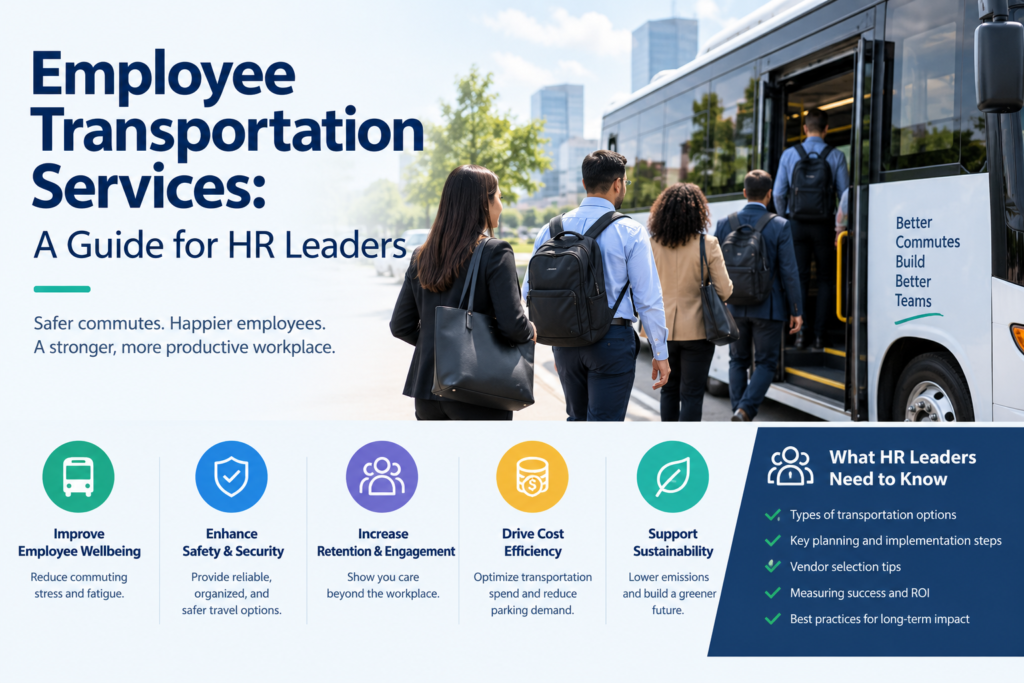
For many organisations, the employee commute is not a minor operational detail. It affects punctuality, attendance, workforce access, employee experience and the way people begin and end their working day. As workforces become more distributed and business hours become more varied, employee transportation services can give HR leaders a structured way to support daily mobility. The right approach is not simply to arrange vehicles. It is to design a safe, dependable and clearly governed transport experience that fits the organisation’s workforce, locations, schedules and policies. This guide explains what employee transportation services include, why they matter to HR leaders, how to evaluate a provider and which questions should be answered before implementation. Key Takeaways •Employee transportation services can support punctuality, access to the workplace and a more predictable employee experience. •A successful programme starts with employee travel patterns, work schedules, pickup requirements and safety expectations. •HR leaders should assess coordination, driver and vehicle standards, communication, privacy, incident processes and reporting before selecting a partner. •Transport should be treated as part of workforce experience and corporate mobility—not only as a vehicle-booking exercise. What Are Employee Transportation Services? Employee transportation services are organised mobility solutions that help employees travel between agreed pickup points, residential areas, offices, business facilities or other approved locations. Depending on the organisation, the service may support daily commuting, shift movement, late-hour travel, office transfers, business visits or specific workforce groups. The exact model can vary. It may involve scheduled routes, point-to-point movement, pooled transport, dedicated vehicles, employee shuttles or individually coordinated journeys. The most suitable option depends on factors such as workforce size, office locations, shift patterns, distance, budget, local transport conditions and company policy. For HR teams, the central question is not only, “Can employees reach the office?” It is also: Can the organisation provide a consistent, well-coordinated and responsibly managed travel experience that supports both employee needs and business requirements? [INTERNAL-LINK: corporate transportation services → Fiaara corporate service page] Why Should HR Leaders Pay Attention to Employee Transportation? Employee transportation sits at the intersection of people operations, facilities, administration, finance, safety and business continuity. A poorly organised commute can create recurring friction, while a well-designed programme can make workplace access more predictable. 1. It can support punctuality and schedule reliability When employees depend on inconsistent or limited public transport, arrival times may be difficult to predict. A coordinated transport programme can create clearer departure windows and planned movement between designated points. This is especially relevant for organisations with fixed start times, multiple shifts, early-morning operations, late working hours or offices located away from major public transport routes. Transportation does not eliminate every delay, but it can give the organisation a more structured way to plan and communicate daily movement. 2. It can improve the employee experience The workday begins before an employee enters the office. Long or uncertain commutes can affect energy, stress and the overall perception of the employer. A comfortable, respectful and clearly communicated transport service can remove some avoidable friction from the daily routine. HR leaders should avoid treating convenience as a luxury. For many employees, especially those travelling at unusual hours or across difficult routes, access to practical transport can influence how manageable the job feels. 3. It can support workforce access Transport can be a consideration in recruitment and retention, particularly when an organisation operates in an area that is difficult to reach or requires attendance outside standard hours. An employer-supported commute may help more employees consider a role that would otherwise be challenging to access. The result should not be presented as a guaranteed hiring or retention outcome. Instead, HR teams should evaluate whether transportation solves a real access problem for their workforce and whether employees value the proposed service. 4. It can strengthen operational coordination A centralised transportation process can give HR and administration teams a clearer view of routes, schedules, employee communication and service issues. This is often more manageable than handling informal travel arrangements across multiple teams. A transport programme should have defined ownership. HR may lead the employee experience, facilities may manage locations, finance may review cost and procurement may assess vendors. Clear responsibility prevents gaps when a route changes or an incident needs attention. What Should an Employee Transportation Programme Include? A strong programme is built around more than a route map. It should include the operating principles, communication process and service standards that make the daily journey dependable. Workforce and route assessment Begin with data and employee input. Understand where employees live, where they work, when they travel and which groups face the greatest access challenges. Useful information may include: •Office and facility locations. •Employee concentration by area. •Shift and roster timings. •Existing commute methods. •Common late-arrival or access concerns. •Accessibility requirements. •Preferred pickup points and reasonable walking distances. •Seasonal or occasional demand. Do not assume that a single route model will suit every workforce. A hybrid approach may be more appropriate for organisations with different shifts, locations or employee populations. Scheduling and coordination Employees need clear information about pickup windows, meeting points, service changes and escalation contacts. The schedule should be practical rather than overly ambitious. It should include appropriate time allowances and a process for communicating changes. A reliable service is not defined only by speed. It is also defined by predictability, clarity and the ability to respond professionally when circumstances change. Safety and responsible operations Safety should be a core evaluation category, not an afterthought. HR leaders should ask how a prospective partner manages vehicle condition, driver standards, route planning, passenger communication, emergency escalation and incident reporting. The applicable legal and operational requirements will vary by location and service model. Employers should obtain independent legal, insurance and compliance advice where needed, and confirm that the selected provider can meet the organisation’s own standards. The U.S. Department of Labor notes that travel during normal working hours may be treated differently from ordinary home-to-work travel under U.S. wage-and-hour rules. This is a reminder that transport policy can have employment-law implications depending on