
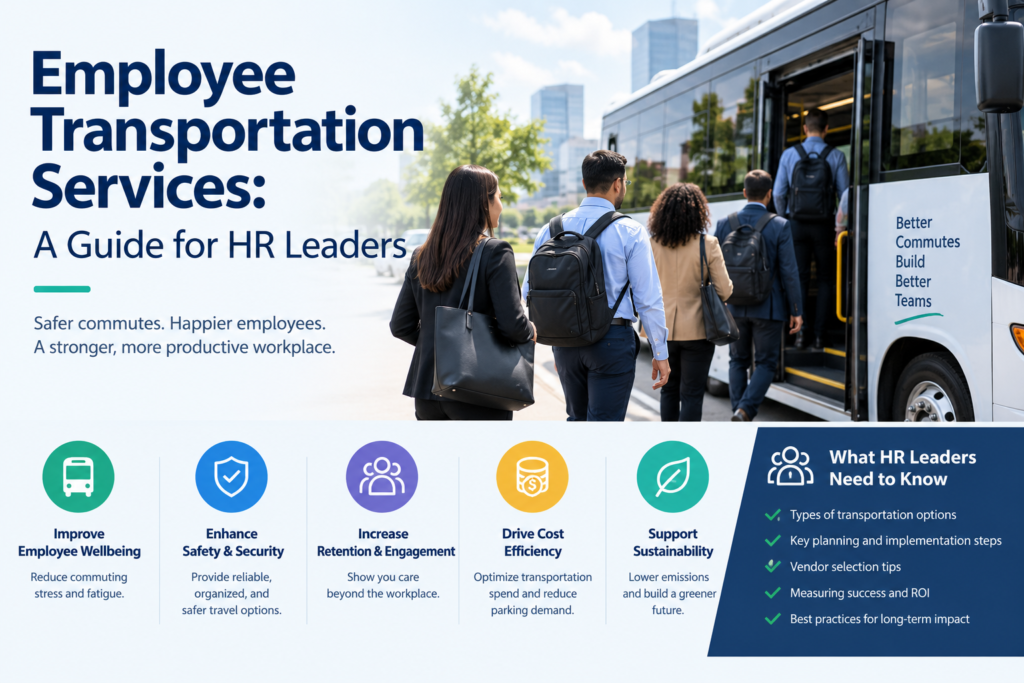
For many organisations, the employee commute is not a minor operational detail. It affects punctuality, attendance, workforce access, employee experience and the way people begin and end their working day. As workforces become more distributed and business hours become more varied, employee transportation services can give HR leaders a structured way to support daily mobility.
The right approach is not simply to arrange vehicles. It is to design a safe, dependable and clearly governed transport experience that fits the organisation’s workforce, locations, schedules and policies.
This guide explains what employee transportation services include, why they matter to HR leaders, how to evaluate a provider and which questions should be answered before implementation.
Key Takeaways
•Employee transportation services can support punctuality, access to the workplace and a more predictable employee experience.
•A successful programme starts with employee travel patterns, work schedules, pickup requirements and safety expectations.
•HR leaders should assess coordination, driver and vehicle standards, communication, privacy, incident processes and reporting before selecting a partner.
•Transport should be treated as part of workforce experience and corporate mobility—not only as a vehicle-booking exercise.
What Are Employee Transportation Services?
Employee transportation services are organised mobility solutions that help employees travel between agreed pickup points, residential areas, offices, business facilities or other approved locations. Depending on the organisation, the service may support daily commuting, shift movement, late-hour travel, office transfers, business visits or specific workforce groups.
The exact model can vary. It may involve scheduled routes, point-to-point movement, pooled transport, dedicated vehicles, employee shuttles or individually coordinated journeys. The most suitable option depends on factors such as workforce size, office locations, shift patterns, distance, budget, local transport conditions and company policy.
For HR teams, the central question is not only, “Can employees reach the office?” It is also:
Can the organisation provide a consistent, well-coordinated and responsibly managed travel experience that supports both employee needs and business requirements?
[INTERNAL-LINK: corporate transportation services → Fiaara corporate service page]
Why Should HR Leaders Pay Attention to Employee Transportation?
Employee transportation sits at the intersection of people operations, facilities, administration, finance, safety and business continuity. A poorly organised commute can create recurring friction, while a well-designed programme can make workplace access more predictable.
1. It can support punctuality and schedule reliability
When employees depend on inconsistent or limited public transport, arrival times may be difficult to predict. A coordinated transport programme can create clearer departure windows and planned movement between designated points.
This is especially relevant for organisations with fixed start times, multiple shifts, early-morning operations, late working hours or offices located away from major public transport routes. Transportation does not eliminate every delay, but it can give the organisation a more structured way to plan and communicate daily movement.
2. It can improve the employee experience
The workday begins before an employee enters the office. Long or uncertain commutes can affect energy, stress and the overall perception of the employer. A comfortable, respectful and clearly communicated transport service can remove some avoidable friction from the daily routine.
HR leaders should avoid treating convenience as a luxury. For many employees, especially those travelling at unusual hours or across difficult routes, access to practical transport can influence how manageable the job feels.
3. It can support workforce access
Transport can be a consideration in recruitment and retention, particularly when an organisation operates in an area that is difficult to reach or requires attendance outside standard hours. An employer-supported commute may help more employees consider a role that would otherwise be challenging to access.
The result should not be presented as a guaranteed hiring or retention outcome. Instead, HR teams should evaluate whether transportation solves a real access problem for their workforce and whether employees value the proposed service.
4. It can strengthen operational coordination
A centralised transportation process can give HR and administration teams a clearer view of routes, schedules, employee communication and service issues. This is often more manageable than handling informal travel arrangements across multiple teams.
A transport programme should have defined ownership. HR may lead the employee experience, facilities may manage locations, finance may review cost and procurement may assess vendors. Clear responsibility prevents gaps when a route changes or an incident needs attention.
What Should an Employee Transportation Programme Include?
A strong programme is built around more than a route map. It should include the operating principles, communication process and service standards that make the daily journey dependable.
Workforce and route assessment
Begin with data and employee input. Understand where employees live, where they work, when they travel and which groups face the greatest access challenges. Useful information may include:
•Office and facility locations.
•Employee concentration by area.
•Shift and roster timings.
•Existing commute methods.
•Common late-arrival or access concerns.
•Accessibility requirements.
•Preferred pickup points and reasonable walking distances.
•Seasonal or occasional demand.
Do not assume that a single route model will suit every workforce. A hybrid approach may be more appropriate for organisations with different shifts, locations or employee populations.
Scheduling and coordination
Employees need clear information about pickup windows, meeting points, service changes and escalation contacts. The schedule should be practical rather than overly ambitious. It should include appropriate time allowances and a process for communicating changes.
A reliable service is not defined only by speed. It is also defined by predictability, clarity and the ability to respond professionally when circumstances change.
Safety and responsible operations
Safety should be a core evaluation category, not an afterthought. HR leaders should ask how a prospective partner manages vehicle condition, driver standards, route planning, passenger communication, emergency escalation and incident reporting.
The applicable legal and operational requirements will vary by location and service model. Employers should obtain independent legal, insurance and compliance advice where needed, and confirm that the selected provider can meet the organisation’s own standards.
The U.S. Department of Labor notes that travel during normal working hours may be treated differently from ordinary home-to-work travel under U.S. wage-and-hour rules. This is a reminder that transport policy can have employment-law implications depending on the journey and jurisdiction; HR teams should review local requirements rather than relying on a generic policy. U.S. Department of Labor travel-time guidance
Privacy and employee information
Transport planning may involve employee names, addresses, phone numbers, work schedules and emergency contacts. Organisations should collect only the information needed to operate the service, limit access appropriately and explain how the data will be used.
Privacy is also relevant during the journey itself. Employees should be treated respectfully, and sensitive workplace information should not be exposed through informal communication or unnecessary sharing of route data.
Feedback and service improvement
A programme should have a way to learn from the people using it. HR teams can use short surveys, structured feedback, attendance trends and service reports to identify recurring issues.
Feedback should lead to action where appropriate. Examples include changing a pickup point, adjusting a departure window, improving communication or reviewing whether a route is still serving the intended workforce.
How Should HR Leaders Evaluate an Employee Transportation Provider?
Before selecting a provider, HR and procurement teams should assess the service model, operational discipline and quality of communication. Price matters, but the lowest initial quote may not represent the lowest total cost if it creates repeated complaints, missed journeys or administrative work.
Use the following evaluation areas as a starting point.
Service fit
Can the provider support the organisation’s locations, working hours, route complexity and employee requirements? Ask whether the proposed model is suitable for regular journeys, occasional business movement or both.
Coordination quality
Who is the day-to-day contact? How are route changes, employee updates and urgent issues communicated? A clear operating contact can be as important as the vehicle itself.
Safety and incident process
Ask for an explanation of driver onboarding, vehicle checks, incident escalation and service review procedures. Request documentation appropriate to the organisation’s jurisdiction and risk policy.
Communication experience
Employees should know where to find accurate information. Assess whether the provider can support clear instructions, schedule updates and a respectful escalation process.
Privacy and professionalism
The provider should understand that employee transportation is a workplace service. Professional conduct, discretion and responsible information handling should be part of the relationship.
Reporting and review
Ask what service information can be shared with authorised stakeholders. Depending on the arrangement, useful reporting may cover completed journeys, exceptions, feedback themes and agreed service measures. Do not request personal data that is not necessary for the review.
Scalability and flexibility
Workforces change. New offices open, shifts change and employee demand varies. Confirm how routes, schedules and passenger numbers can be reviewed without creating unnecessary disruption.
A Practical Implementation Framework for HR Teams
HR leaders can reduce implementation risk by introducing employee transportation in clear stages.
Stage 1: Define the business problem
Identify what the organisation is trying to improve. Is the main issue access to a remote office, early or late shifts, employee safety concerns, unreliable commuting options or administrative complexity?
A clear problem statement prevents the programme from becoming an expensive service without a measurable purpose.
Stage 2: Gather employee and operational data
Review work locations, shifts, commute patterns, attendance concerns and employee feedback. Protect personal information during collection and use the data only for defined planning purposes.
Stage 3: Select the service model
Compare possible models such as scheduled routes, pooled transport, point-to-point journeys or a combination. Consider employee needs, operational feasibility and the level of coordination the HR team can realistically manage.
Stage 4: Establish policies and responsibilities
Document eligibility, booking or registration rules, pickup expectations, cancellations, conduct, safety escalation, privacy and feedback. Assign responsibility across HR, facilities, procurement and the service provider.
Stage 5: Pilot and listen
A limited pilot can help the organisation test routes, communication and employee experience before a wider rollout. Define what will be reviewed and when.
Stage 6: Review and improve
Use agreed service measures and employee feedback to decide what should change. A transportation programme should be reviewed as workforce needs and business locations evolve.
Common Mistakes to Avoid
Choosing a provider based only on price
A low price does not automatically mean good value. Consider coordination, safety, communication, administration and the employee experience alongside cost.
Designing routes without employee input
A route that looks efficient on a map may be inconvenient in practice. Ask employees about safe, practical and accessible pickup points.
Making unsupported promises
Avoid promising exact arrival times, guaranteed availability or universal coverage unless these commitments are contractually and operationally confirmed.
Ignoring non-standard work hours
A transport model designed only for a standard office schedule may not serve shift workers or teams with late departures. Review the full working pattern.
Collecting more employee data than necessary
Use a purpose-led approach to information. Clear data handling improves trust and reduces avoidable privacy risk.
Treating feedback as a one-time exercise
Employee transportation needs can change. Keep a regular review process rather than assuming the original route design will remain suitable indefinitely.
How Fiaara Can Support Corporate Mobility Conversations
Fiaara positions itself as a discreet, dependable and professional travel and logistics partner for corporate leaders, international visitors and high-profile delegates. Its service approach is built around three priorities:
•Comfort: thoughtful movement planning and a smoother travel experience.
•Privacy: respectful, discreet and professional service.
•Cultural authenticity: meaningful local experiences when business travel allows time for them.
For organisations reviewing employee or corporate transportation requirements, Fiaara can discuss the relevant travel needs, locations, schedules and service expectations before confirming whether the request fits its service area and availability.
This is particularly useful when employee transportation is part of a broader corporate mobility requirement—for example, planned movement between offices, airport transfers for visiting teams, meeting transfers or a business itinerary for international guests.
[INTERNAL-LINK: Fiaara corporate travel services → corporate service landing page]
Planning a corporate transportation programme? Share your locations, working hours, employee requirements and preferred service scope with the Fiaara team: [booking link] | [WhatsApp number] | [email address].
Frequently Asked Questions About Employee Transportation Services
What are employee transportation services?
Employee transportation services are organised travel solutions that help employees move between approved pickup points, residential areas, offices, facilities or other work-related locations. The model may include scheduled routes, pooled transport, shuttles or coordinated point-to-point journeys.
Why are employee transportation services important for HR leaders?
They can support workplace access, schedule reliability, employee experience and operational coordination. Their value depends on whether the service addresses a real workforce need and is managed with appropriate safety, privacy and communication standards.
What should HR check before choosing a provider?
HR should evaluate service fit, route planning, driver and vehicle standards, incident processes, communication, privacy, reporting, scalability, insurance and applicable local requirements.
Should employee transport be available to everyone?
Not necessarily. Eligibility should reflect the organisation’s objectives, workforce needs, locations, shifts and applicable policies. Any eligibility rules should be communicated clearly and reviewed for fairness and practicality.
How can an organisation measure an employee transportation programme?
Possible measures include usage, completed journeys, punctuality indicators, employee feedback, reported incidents, support requests, route utilisation and administrative effort. Measures should be agreed in advance and should respect employee privacy.
Can Fiaara provide employee transportation services?
Fiaara can discuss corporate transportation and travel-logistics requirements based on the organisation’s locations, schedules and service needs. Specific employee transport coverage, routes, availability and operating arrangements should be confirmed directly with the Fiaara team before making a commitment.
Conclusion: Make Employee Mobility a Deliberate HR Decision
Employee transportation services can be an important part of a modern workplace strategy when they solve a clearly defined access or mobility problem. The best programmes are not built around vehicles alone. They combine practical routes, realistic schedules, responsible safety planning, clear communication, privacy and continuous employee feedback.
For HR leaders, the right starting point is to understand the workforce and define the outcome the organisation wants to support. From there, a carefully evaluated corporate transportation partner can help turn daily commuting from a recurring source of friction into a more structured and considered part of the employee experience.
If your organisation is reviewing corporate mobility, employee commute support or business travel coordination, speak with Fiaara about your requirements.
[INTERNAL-LINK: contact Fiaara about corporate transportation → contact or enquiry page]